
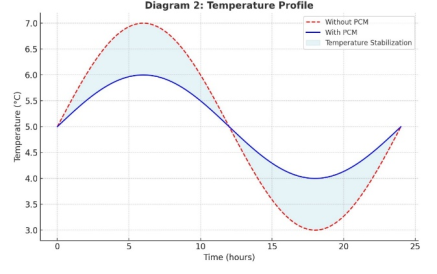
Domestic refrigeration units contribute significantly to household energy consumption. Despite advances in compressor efficiency and insulation, energy demand remains high due to temperature fluctuations and compressor cycling. This paper proposes an innovative PCM-assisted cooling system to stabilize internal temperatures, reduce compressor workload, and lower energy consumption. The integration of phase-change materials (PCMs) in domestic refrigerators represents a transformative approach to thermal management, leveraging latent heat storage to mitigate the inefficiencies inherent in conventional vapor compression cycles. By embedding PCM panels with phase transition temperatures around 0-5°C, the system can absorb excess heat during door openings or off-cycles, thereby minimizing temperature swings that trigger unnecessary compressor activations. Experimental validations from recent studies demonstrate potential energy savings of 25-40%, aligning with global sustainability goals under frameworks like the Paris Agreement. Furthermore, this technology extends to off-grid food preservation, where PCM-based pods maintain sub-ambient temperatures without electricity, addressing food waste in developing regions. A comparative analysis of organic PCMs, such as paraffin wax, and inorganic options like salt hydrates reveals trade-offs in thermal conductivity and cost, with encapsulated hybrids offering optimal performance. Thermodynamic modeling, including exergy analysis, underscores reduced entropy generation and enhanced coefficient of performance (COP). Challenges such as material encapsulation and scalability are discussed, alongside future directions involving nano-enhanced PCMs for superior heat transfer. This work not only quantifies benefits through CFD simulations but also proposes adaptive control algorithms integrating Internet of Things (IoT) sensors for real-time optimization. Ultimately, PCM-assisted systems pave the way for energy-efficient, resilient food preservation, potentially cutting global refrigeration-related CO2 emissions by 15% by 2030.
| Published in | American Journal of Mechanical and Materials Engineering (Volume 10, Issue 1) |
| DOI | 10.11648/j.ajmme.20261001.11 |
| Page(s) | 1-7 |
| Creative Commons |
This is an Open Access article, distributed under the terms of the Creative Commons Attribution 4.0 International License (http://creativecommons.org/licenses/by/4.0/), which permits unrestricted use, distribution and reproduction in any medium or format, provided the original work is properly cited. |
| Copyright |
Copyright © The Author(s), 2026. Published by Science Publishing Group |
Phase-change Materials, Energy Efficiency, Domestic Refrigeration, Thermal Energy Storage, Efficient Food Preservation, Sustainability
Type | Examples | Advantages | Disadvantages |
|---|---|---|---|
Type-1: Organic | Fatty acids, paraffin wax | Biodegradable, non-toxic | Lower thermal conductivity |
Type-2: Inorganic | Salt hydrates | High latent heat capacity | Prone to leakage, require encapsulation |
PCM | Phase-Change Material |
COP | Coefficient of Performance |
CFD | Computational Fluid Dynamics |
IoT | Internet of Things |
CO2 | Carbon Dioxide |
DOE | Department of Energy |
NREL | National Renewable Energy Laboratory |
NTC | Negative Temperature Coefficient |
PID | Proportional-Integral-Derivative |
TEGs | Thermoelectric Generators |
IOP | Institute of Physics |
RSC | The Royal Society of Chemistry |
ROI | Return on Investment |
FAO | Food and Agriculture Organization |
ML | Machine Learning |
GHG | Greenhouse Gas |
API | Application Programming Interface |
UN | United Nations |
SDGs | Sustainable Development Goals |
LCA | Life Cycle Assessment |
| [1] | Zhang, Y., et al. (2021). "Phase-change materials for thermal energy storage: Advances and applications." Renewable Energy Journal. |
| [2] | Li, X., et al. (2022). "Energy-efficient refrigeration through phase-change materials." International Journal of Refrigeration. |
| [3] | ASHRAE Handbook (2020). "Refrigeration Systems and Applications." |
| [4] | A. Sharma, V. V. Tyagi, et al., Renewable Energy and Sustainable Systems, 2023. |
| [5] | Huang, R., Mahvi, A., Kozubal, E., & Woods, J. (2022). Design of phase-change thermal storage device in a heat pump for building electric peak load shaving (NREL Report No. CP-5500-82660). National Renewable Energy Laboratory. |
| [6] | M. Kalaiselvam and R. Parameshwaran, Thermal Energy Storage Technologies: Theoretical and Practical Aspects, 2018. |
| [7] |
Gao, Y., et al. (2023). High-Efficiency Refrigerator with Cold Energy Storage Enabling Energy Savings and Demand Flexibility. U.S. Department of Energy Building Technologies Office Peer Review.
https://www.energy.gov/sites/default/files/2023-07/bto-peer-2023-32648-heres-ornl-gao.pdf |
| [8] |
Race for 2030. (2024). Using phase change materials for flexible demand in industrial refrigeration.
https://www.racefor2030.com.au/content/uploads/B4-using-phase-change-materials-REPORT.pdf |
| [9] |
International Journal of Scientific Engineering and Technology. (2023). Review of Applications of Phase Change Materials for Refrigeration and Cooling Systems.
https://www.ijset.in/wp-content/uploads/IJSET_V13_issue1_163.pdf |
| [10] |
Han, L., et al. (2025). Releasing the potential of phase change materials in domestic refrigeration: A comprehensive review. Applied Thermal Engineering.
https://www.sciencedirect.com/science/article/pii/S1359431125000122 |
| [11] | Qureshi, M. I., et al. (2025). Advancing Domestic Freezers With Phase Change Materials for Enhanced Energy Efficiency and Thermal Stability. Heat Transfer. |
| [12] |
Springer. (2024). Passive domestic air-conditioning using PCM modules. International Journal of Dynamics and Control.
https://link.springer.com/article/10.1007/s41062-024-01611-5 |
| [13] |
Radhi, M. M., Farhan, J. J., & Khalifa, A. N. (2021). Experimental study of cold storage packed domestic refrigerator with solar powered variable speed compressor. IOP Conference Series: Materials Science and Engineering.
https://iopscience.iop.org/article/10.1088/1757-899X/1105/1/012060 |
| [14] |
Elsevier. (2025). Experimental investigation of phase change material integrated domestic refrigerator. Applied Thermal Engineering.
https://www.sciencedirect.com/science/article/abs/pii/S1359431125007100 |
| [15] | ResearchGate. (2025). Heat and cold storage using phase change materials in domestic refrigeration systems: The state-of-the-art review. |
| [16] | MDPI. (2024). A Review on Phase-Change Materials (PCMs) in Solar-Powered Refrigeration Systems. Energies. |
| [17] | AccScience. (2024). Implementation of sustainable refrigeration technology with phase change materials. Green Technologies and Infrastructure. |
| [18] | ResearchGate. (2022). Development and testing of a PCM enhanced domestic refrigerator with use of miniature DC compressor for weak/off-grid locations. |
| [19] | MDPI. (2025). Performance Analysis of Refrigeration System with Thermal Energy Storage Using Phase Change Material. Journal of Manufacturing and Materials Processing. |
| [20] | Minnesota Department of Commerce. (2024). Field study of phase change material (PCM) use for passive thermal management in buildings. |
| [21] |
Purdue University. (2022). PCM Material Selection For Heat Pump Integrated With Thermal Energy Storage. International High Performance Buildings Conference.
https://docs.lib.purdue.edu/cgi/viewcontent.cgi?article=1426&context=ihpbc |
| [22] | NREL. (2022). Design of Phase-Change Thermal Storage Device in a Heat Pump for Load Shifting and Demand Response. |
| [23] | International Journal of Scientific Research and Analysis. (2024). Phase Change Materials (PCMs) for passive Cooling. |
| [24] | Husainy A. et al. ES Publisher. (2025). Nano-Enhanced Phase Change Materials. Environmental and Sustainability Indicators. |
| [25] |
Jain, N. K., et al. (2023). Characterization and effectiveness analysis of ternary organic eutectic mixture/hybrid-nanoparticles based phase change material for cold storage applications. Google Scholar.
https://scholar.google.com/citations?user=M1HFNyIAAAAJ&hl=en |
| [26] |
Karthikeyan, K., et al. (2023). Characterization and thermal properties of Lauryl alcohol–Capric acid with CuO and TiO2 nanoparticles as phase change material for cold storage system. Google Scholar.
https://scholar.google.com/citations?user=3JnhCssAAAAJ&hl=en |
| [27] |
Wright, E., et al. (2022). An extensive analysis of the utilisation of phase change materials in food storage and transportation. Asia-Pacific Journal of Chemical Engineering.
https://scholar.google.com/citations?user=JPeH_ZwAAAAJ&hl=en |
| [28] |
Bozorgi, M., et al. (2023). Phase change material-enhanced solid-state thermoelectric cooling technology for food refrigeration and storage applications. Google Scholar.
https://scholar.google.com/citations?user=pbK7zTwAAAAJ&hl=en |
| [29] |
Kale, S., et al. (2024). Nano-enhanced phase change materials: a novel approach to sustainable refrigeration and thermal energy storage. Google Scholar.
https://scholar.google.com/citations?user=bVwjFygAAAAJ&hl=en |
| [30] |
Ray, A., et al. (2024). Comparative Analysis of Phase Change Materials as Solar Thermal Energy Storage for Yogurt Incubation. International Journal of Engineering Research & Technology.
https://scholar.google.com/citations?user=EcZcJPgAAAAJ&hl=en |
APA Style
Pasha, A. M. (2026). Phase-change Material-based Thermal Management for Energy-efficient and Sustainable Food Preservation Systems. American Journal of Mechanical and Materials Engineering, 10(1), 1-7. https://doi.org/10.11648/j.ajmme.20261001.11
ACS Style
Pasha, A. M. Phase-change Material-based Thermal Management for Energy-efficient and Sustainable Food Preservation Systems. Am. J. Mech. Mater. Eng. 2026, 10(1), 1-7. doi: 10.11648/j.ajmme.20261001.11
@article{10.11648/j.ajmme.20261001.11,
  author = {Ali Mansoor Pasha},
  title = {Phase-change Material-based Thermal Management for Energy-efficient and Sustainable Food Preservation Systems},
  journal = {American Journal of Mechanical and Materials Engineering},
  volume = {10},
  number = {1},
  pages = {1-7},
  doi = {10.11648/j.ajmme.20261001.11},
  url = {https://doi.org/10.11648/j.ajmme.20261001.11},
  eprint = {https://article.sciencepublishinggroup.com/pdf/10.11648.j.ajmme.20261001.11},
  abstract = {Domestic refrigeration units contribute significantly to household energy consumption. Despite advances in compressor efficiency and insulation, energy demand remains high due to temperature fluctuations and compressor cycling. This paper proposes an innovative PCM-assisted cooling system to stabilize internal temperatures, reduce compressor workload, and lower energy consumption. The integration of phase-change materials (PCMs) in domestic refrigerators represents a transformative approach to thermal management, leveraging latent heat storage to mitigate the inefficiencies inherent in conventional vapor compression cycles. By embedding PCM panels with phase transition temperatures around 0-5°C, the system can absorb excess heat during door openings or off-cycles, thereby minimizing temperature swings that trigger unnecessary compressor activations. Experimental validations from recent studies demonstrate potential energy savings of 25-40%, aligning with global sustainability goals under frameworks like the Paris Agreement. Furthermore, this technology extends to off-grid food preservation, where PCM-based pods maintain sub-ambient temperatures without electricity, addressing food waste in developing regions. A comparative analysis of organic PCMs, such as paraffin wax, and inorganic options like salt hydrates reveals trade-offs in thermal conductivity and cost, with encapsulated hybrids offering optimal performance. Thermodynamic modeling, including exergy analysis, underscores reduced entropy generation and enhanced coefficient of performance (COP). Challenges such as material encapsulation and scalability are discussed, alongside future directions involving nano-enhanced PCMs for superior heat transfer. This work not only quantifies benefits through CFD simulations but also proposes adaptive control algorithms integrating Internet of Things (IoT) sensors for real-time optimization. Ultimately, PCM-assisted systems pave the way for energy-efficient, resilient food preservation, potentially cutting global refrigeration-related CO2 emissions by 15% by 2030.},
 year = {2026}
}
TY  - JOUR
T1  - Phase-change Material-based Thermal Management for Energy-efficient and Sustainable Food Preservation Systems
AU  - Ali Mansoor Pasha
Y1  - 2026/01/26
PY  - 2026
N1  - https://doi.org/10.11648/j.ajmme.20261001.11
DO  - 10.11648/j.ajmme.20261001.11
T2  - American Journal of Mechanical and Materials Engineering
JF  - American Journal of Mechanical and Materials Engineering
JO  - American Journal of Mechanical and Materials Engineering
SP  - 1
EP  - 7
PB  - Science Publishing Group
SN  - 2639-9652
UR  - https://doi.org/10.11648/j.ajmme.20261001.11
AB  - Domestic refrigeration units contribute significantly to household energy consumption. Despite advances in compressor efficiency and insulation, energy demand remains high due to temperature fluctuations and compressor cycling. This paper proposes an innovative PCM-assisted cooling system to stabilize internal temperatures, reduce compressor workload, and lower energy consumption. The integration of phase-change materials (PCMs) in domestic refrigerators represents a transformative approach to thermal management, leveraging latent heat storage to mitigate the inefficiencies inherent in conventional vapor compression cycles. By embedding PCM panels with phase transition temperatures around 0-5°C, the system can absorb excess heat during door openings or off-cycles, thereby minimizing temperature swings that trigger unnecessary compressor activations. Experimental validations from recent studies demonstrate potential energy savings of 25-40%, aligning with global sustainability goals under frameworks like the Paris Agreement. Furthermore, this technology extends to off-grid food preservation, where PCM-based pods maintain sub-ambient temperatures without electricity, addressing food waste in developing regions. A comparative analysis of organic PCMs, such as paraffin wax, and inorganic options like salt hydrates reveals trade-offs in thermal conductivity and cost, with encapsulated hybrids offering optimal performance. Thermodynamic modeling, including exergy analysis, underscores reduced entropy generation and enhanced coefficient of performance (COP). Challenges such as material encapsulation and scalability are discussed, alongside future directions involving nano-enhanced PCMs for superior heat transfer. This work not only quantifies benefits through CFD simulations but also proposes adaptive control algorithms integrating Internet of Things (IoT) sensors for real-time optimization. Ultimately, PCM-assisted systems pave the way for energy-efficient, resilient food preservation, potentially cutting global refrigeration-related CO2 emissions by 15% by 2030.
VL  - 10
IS  - 1
ER  -
Department of Electrical Engineering, University of Engineering and Technology, Lahore, Pakistan




 Share This Article
 Twitter
 Linked In
 Facebook
 Copy
Copy Download